
Last Updated on April 23, 2026
There are many other accounting software programs that function similarly to QuickBooks. Some of these include Peachtree Sage, Quicken, and older versions of QB, and many users often wish to stop using this software. However, the fear and risk of losing data intimidates them. But thanks to the QuickBooks conversion tool, converting company files from other accounting software has been made easier. Although the tool has certain system requirements for data conversion, they can be fulfilled easily. Let’s delve into the process for the QuickBooks conversion tool download and use to convert the data file.
Our specialists are just a call away to provide professional assistance with the QuickBooks conversion tool. Reach out to 1.855.738.2784, and our Accounting Helpline’s experts will guide you.
What is the QuickBooks Conversion Tool?
Intuit developed the QuickBooks conversion tool to convert company and data files from other accounting software like Peachtree, Sage, and Quicken. QuickBooks Desktop Premier 2018, QuickBooks Desktop Pro 2018, and QuickBooks Desktop Enterprise Solutions 18.0, as well as older versions, may become unusable due to outdated formats. But now, users can convert old files to new versions and use them on QuickBooks Desktop 2025 or QB Online. The conversion utility tool offers various features and benefits that ease your accounting tasks. Some of the benefits you get with the QB conversion tool are listed in the next segment.
Benefits of Using the QuickBooks Desktop Conversion Tool
Let’s take a look at the advantages offered by the QB data conversion tool. It has a simple data transfer process, unlike the manual conversion.
- It provides a better understanding of the current business status.
- All conversions are logged and tracked by the tool for records.
- Importing data from a new QuickBooks Company file is a lot easier with the QB conversion tool.
- The data files remain unaffected, eliminating the risk of data loss.
- A simple setup and conversion process for data.
- You can also choose to list the positive and negative balances, as well as historical transactions, together during the import process.
- The current company files are not affected by the QuickBooks conversion tool.
Although it is highly beneficial, it has certain limitations regarding what it can convert and what it cannot. There is some data and information that cannot be converted, even with the QB data conversion tool.
Data That Can Be Converted Vs Data That Can’t Be Converted Via the QuickBooks Conversion Tool
The QB conversion tool can only convert some data and information from other software or old applications. Let’s take a look at the data that gets converted and the data that cannot be converted. A lot of crucial data, such as payroll items, individual employee wages, and more, cannot be converted even with the QuickBooks conversion tool.
| Data that will convert | Data that won’t convert |
| Account, Employee, Item, Customer, and Vendor lists | Individual employee wage or deduction information. |
| Payroll General ledger account balance info | Payroll transactions and employee year-to-date info in QuickBooks, such as paychecks and year-to-date adjustments. |
| Customer and vendor transactions | Fixed Assets |
| Employee profile and contact info | Payroll items that are used to calculate paychecks (hourly and salary payroll items, deductions, medical insurance, etc.) |
| Account balances | Purchase orders, closed or partially closed sales orders, and estimates. |
| Paychecks (converted as journal entries) | Work Tickets |
In the next segment, we have listed out the specific system requirements that you must fulfill to perform a QuickBooks conversion tool download for usage.
System Requirements to Use the QuickBooks Data Conversion Tool
Your computer should meet the following requirements to run the QB conversion tool smoothly.
| Operating System: | Windows 10, Windows 8.1, Windows 8 |
| Processor: | 500 MHz Intel Pentium II (minimum) |
| Memory (RAM): | 512 MB (minimum) |
| Hard Drive: | 2.5 GB free space |
| Microsoft .NET Framework: | Version 2.0 |
| QuickBooks Desktop: | Pro, Premier, or Enterprise 2018 |
| Sage 50 | Version 2013 and above |
- Windows 7, 8, 10, Windows Vista, or Windows XP is required on your computer.
- Download the .NET 2.0 framework from Microsoft.
- Install and register the QuickBooks Desktop on your device.
- Have at least 512 MB of RAM storage.
After meeting these criteria, you can move ahead with the following process for the QuickBooks conversion tool download.
Detailed Process for QuickBooks Conversion Tool Download
You can follow the step-by-step procedure for the QB conversion tool download as well as to install it on your device, outlined below.
- Download the tool from the Intuit website.
- Navigate to the File Explorer on your system and locate the installation file.
- Right-click the QuickBooks conversion tool file and select Properties.
- Under the Compatibility mode section, tick the ‘Run this program in compatibility mode for’ checkbox.
- Select Windows 8 from the dropdown and hit OK. (even as a Windows 10 user).
- Finally, right-click QuickBooksConversionToolSetup.exe and hit Run as Administrator.
After installation, you can begin setting up the QuickBooks data conversion tool, as outlined in the next section.
Properly Setting up the QuickBooks Desktop Conversion Tool
Before we begin with the process for setting up the QB data conversion tool, you should first install and register for QuickBooks Desktop. After that, follow these steps for setting up the tool on your device.
- Open the Conversion Tool.
- Locate and select either ‘My Client Company’ or ‘My own company’.
- Now choose the accounting software in the dropdown and hit Next.
- Find and click on the required company file, and then tap Next.
- Choose your preferred QuickBooks product.
- Head to the folder containing your saved company file and click on Next.
- Now, decide on the conversion levels according to the list and transactions, or just the list.
- Tap Next and choose accounting preferences depending on the date and name of the company.
- Again, hit Next, and verify the entered details.
- Once verified, click on Start.
The conversion process may be time-consuming, depending on the file size. Once it’s over, the list of conversions will be shown, and you may click Finish to end it.
Note: Conversion is only required when the data is not in QuickBooks format. If it is, then you do not have to convert it using the QB conversion tool.
Now let’s move on to the next section, where we have outlined the procedures to convert data from different accounting software to QuickBooks Desktop or QBO using the conversion tool.
Converting from Different Accounting Software Using the QuickBooks Conversion Tool
You can effectively convert your data from accounting software, like Peachtree, Sage, Quicken, and older versions of QuickBooks, with the help of the following procedures. You can use the QB conversion tool by following the steps below to convert from other software to QuickBooks Desktop.
Section 1: How to Convert Quicken Data to QuickBooks Desktop via Conversion Tool
We have outlined the process for converting and moving your Quicken data to the QB Desktop version in the section below. However, before using the QuickBooks data conversion tool, you will need to use the Quicken converter to update your data file to the latest version.
Do You Need to Use the Quicken Converter?
If you have parallel versions of both Quicken and QuickBooks Desktop from the same year, then you don’t need to use the Quicken converter.
However, if you have two different versions, i.e., Quicken 2018 and QuickBooks Pro, Premier, or Enterprise 2021, then you need to use the Quicken converter to upgrade the data file.
Additionally, Quicken for Mac data files can not be moved by the Quicken converter or conversion utility in QuickBooks. Therefore, you need to either move your data file from Mac to Windows or create a new QuickBooks company file.
Upgrade the Data File by Using the Quicken converter
Follow the process below to upgrade your data file to a compatible version of Quicken for conversion.
- Download the same version of Quicken converter as your QuickBooks Desktop version.
- Select the Quicken converter installation file, then click Next.
- Accept the license agreement terms and hit Next.
- Follow the instructions and start the installation.
- Once it has been installed, launch the Quicken converter.
- Choose ‘I am transferring data from Quicken for Windows’, and click on Get Started.
- Then, tap on ‘Open a data file located on this computer’ and select File.
- Locate and select the Quicken data file (.QDF) and hit OK.
- Click on Convert it!, then press OK.
- Now save your new Quicken Data File (.QDF) file.
- Finally, hit Exit and close the application.
Once you have upgraded your Quicken data file, proceed to the method below to transfer it using the QuickBooks Desktop conversion utility.
How to Move Quicken to QuickBooks Desktop Using Conversion Utility?
You can follow the steps below to move your upgraded data file from Quicken to QB Desktop using the QuickBooks data conversion tool.
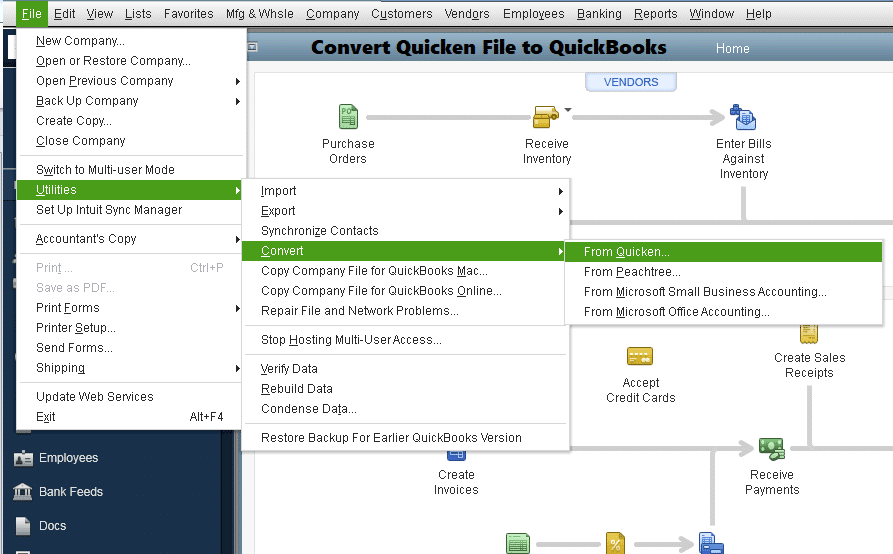
- Launch the QuickBooks Desktop application.
- Expand the File menu on the homepage.
- Locate and select the Utilities option.
- Then, click on Convert and choose From Quicken.
- Now, select the Quicken file (.QDF) for moving.
- After that, follow the instructions from the Conversion Utility to finish the process.
After completing this, your Quicken data will be converted to QuickBooks Desktop. If you want to move from Sage 50 to the QB Desktop conversion tool, then refer to the following method.
Section 2: Convert Data from Peachtree Sage to QuickBooks Conversion Tool
You can convert and move your data file from Peachtree Sage 50 to QuickBooks Desktop via the QB conversion utility through this method. Follow the procedure outlined below to initiate the data transfer.
Step 1: Setting up Data Access Credentials
- Head to the Peachtree Sage application.
- Locate and go to the company file.
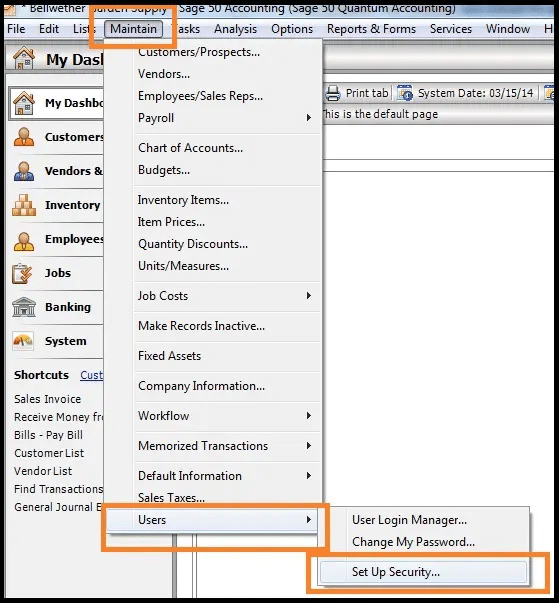
- Now, expand the Maintain menu on the homepage.

- Click on the Users option and select ‘Set Up Security…’
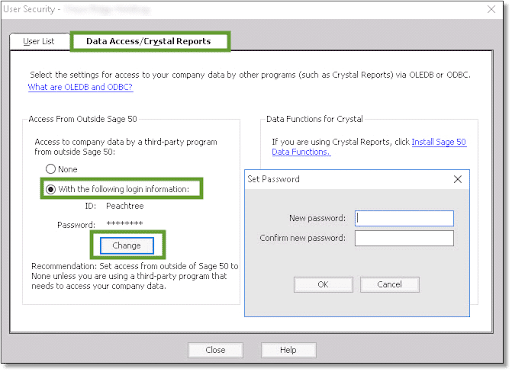
- Then, open the Data Access/Crystal Reports section.

- Select ‘Change’ to set a new password.
- Click OK and then exit the application.
Step 2: Choosing the Sage Company File
After you have set up credentials for data access, go through the following step to choose the Sage company file for the Peachtree to QuickBooks conversion tool.
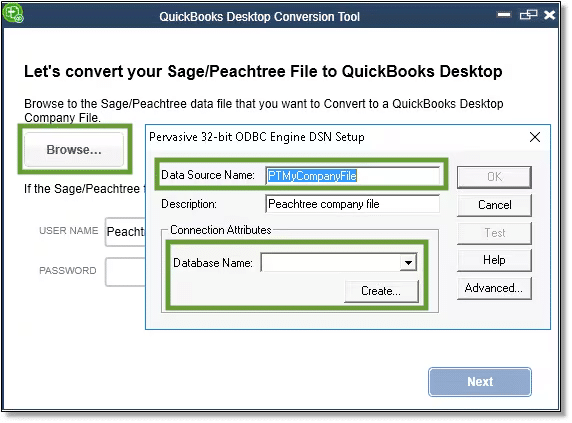
- Visit the Intuit website and download the QuickBooks conversion tool.
- Install the tool and select ‘Run as Administrator’.
- Go to the file explorer and click on the QuickBooksConversionToolSetup.exe file.
- Again, select the option to ‘Run as Admin’.
- Under the Database Name window, select Browse.
- Then choose your company file and tap OK.
Step 3: Converting the Company File
Follow this process to convert your company file from Sage to the QuickBooks conversion tool.
- Select your preferred QuickBooks version for conversion.
- Now, decide on a folder to save your QuickBooks file in.
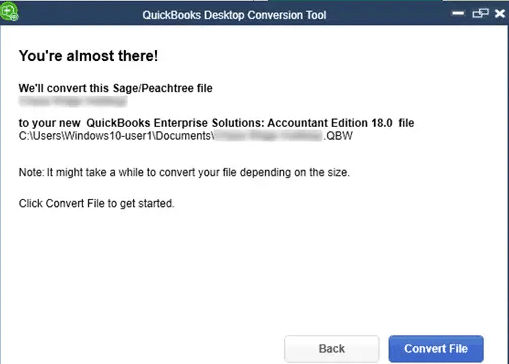
- Then, hit Next and verify the entered details in the new window.
- Now, tap the Convert File button to initiate the process.

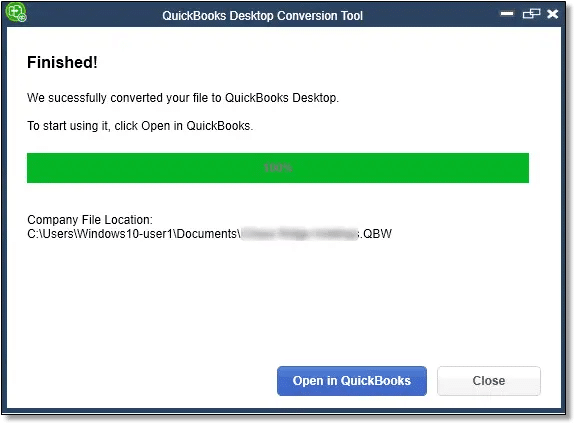
- Once it’s done, click on the Open in QuickBooks option.

Step 4: Verifying the Conversion
After running the Peachtree to QuickBooks conversion tool, follow these steps to verify that the data file has been converted successfully.
- Head to the File Explorer on your system.
- Locate the C:\USERS[Your Windows User Name]\My Documents\Intuit\QuickBooks.
- Now, review and verify the failed transaction log in the folder.
- Check whether the data file has been moved.
Note: The QuickBooks conversion tool only allows you to convert versions of Sage 50 and QB Desktop that are from the same region
Some Common Challenges of the QuickBooks Conversion Tool
Although the QB data conversion tool is very handy and allows for smooth transferring of data, it does have certain limitations as well. The QuickBooks conversion tool faces some disadvantages when importing data, transactions, and account balances from other accounting software to QBDT. It supports the conversion of employee list details, which include the social security number and payroll general ledger account balance information.
However, the QB conversion tool struggles to convert specified payroll data, including paycheck, employee year-to-date information, payroll items, individual employee wages, and more. Additionally, the QuickBooks data conversion tool faces limitations in converting job costing, fixed asset item work tickets, closed or partially closed sales orders, purchase orders, and estimates.
Quickview Table for QuickBooks Conversion Tool
Tabulated below is a summary of the blog that provides a concise overview of the QB data conversion tool:
| What is the QuickBooks Conversion Tool? | QuickBooks conversion tool is developed by Intuit to convert company files and data from other accounting software like Peachtree, Sage, Quicken, and old QB versions to the new format for use in QB Desktop. |
| Its benefits | Better understanding of current business status, tracks and records all the conversions, imports data from new company files, data files remain unaffected, streamlined setup and conversion process, lists positive and negative balances and historical transactions, and current company files are not affected. |
| System requirements | QuickBooks Desktop Pro, Premier, or Enterprise 2018, 500 MHz Intel Pentium II processor, 512 MB RAM, 2.5 GB free space in hard drive, Windows 10, 8.1, or 8 operating system, Microsoft .NET Framework version 2.0, Sage 50 version 2013 and above |
| How to install | Download the tool from the Intuit website, open the installation file, open properties, click on ‘run this program in compatibility mode for’ checkbox, select Windows 8, and hit ok Choose the QuickBooksConversionToolSetup.exe and hit run as administrator. |
What You Should Remember
The QuickBooks conversion tool is very helpful for users to convert data from other accounting software, like Peachtree, Sage, Quicken, and older versions of QuickBooks, to the latest versions. Both businesses and individuals can use this tool to convert their data from one software to another safely. The QB data conversion tool can be used without the fear and risk of losing data during the file transfer. Although it is simple and straightforward to use, some errors can occur as well. Therefore, you can connect with our specialists and get support to use the QuickBooks conversion tool. You may reach out to 1.855.738.2784 to get guidance from our Accounting Helpline’s experts.
Frequently Asked Questions (FAQs)
Can I convert Quicken files to QuickBooks?
Yes, it is possible to convert Quicken files to QuickBooks Desktop using the QB data conversion tool. You can start by downloading same version of Quicken converter as QuickBooks Desktop, installing the Quicken converter then you have to choose ‘I am transferring data from Quicken for Windows’ and tap on Get Started, select ‘Open a data file located on this computer’ and choose your Quicken data file (.QDF) then hit Convert it!, and finish by saving your new Quicken Data File (.QDF).
How to convert Sage 50 to QuickBooks Desktop?
If you want to convert Peachtree Sage 50 to QuickBooks Desktop using the QB conversion tool, then follow the steps outlined below.
– Head to Sage and open the company file.
– Go to the Maintain menu and select Users, followed by ‘Set Up Security…’.
– Open the Data Access/Crystal Reports section and select ‘Change’ to set a new password.
– Go to the file explorer and select QuickBooksConversionToolSetup.exe.
– Choose your company file and hit OK.
– Select the QuickBooks version for conversion and save it.
– Head to file explorer and locate C:\USERS[Your Windows User Name]\My Documents\Intuit\QuickBooks.
Related Posts-
The Guide You Need to Fix QuickBooks Direct Deposit Issues
How To Fix QuickBooks Error PS038? Easiest Method
QuickBooks Error H202 in Multi-User & Solutions to Fix it
Powerful Methods to Overcome QuickBooks Payroll Error PS036
A Comprehensive Guide to the QuickBooks Migration Tool for Data Transferring
Fix QuickBooks Error 1601: Problem with Windows Installer

Edward Martin is a Technical Content Writer for our leading Accounting firm. He has over 10 years of experience in QuickBooks and Xero. He has also worked with Sage, FreshBooks, and many other software platforms. Edward’s passion for clarity, accuracy, and innovation is evident in his writing. He is well versed in how to simplify complex technical concepts and turn them into easy-to-understand content for our readers.